Introduction
The benefits of push-ups are easy to overlook because the exercise itself is so simple.
Get on the floor. Push yourself up. Lower yourself back down. Repeat.
There are no machines to learn, no complicated technique and no equipment to buy. And yet, despite being one of the oldest exercises around, push-ups are still one of the best ways to work your upper body using nothing but your own bodyweight.
Sometimes simple really is better.
Push-Ups Build Upper-Body Strength
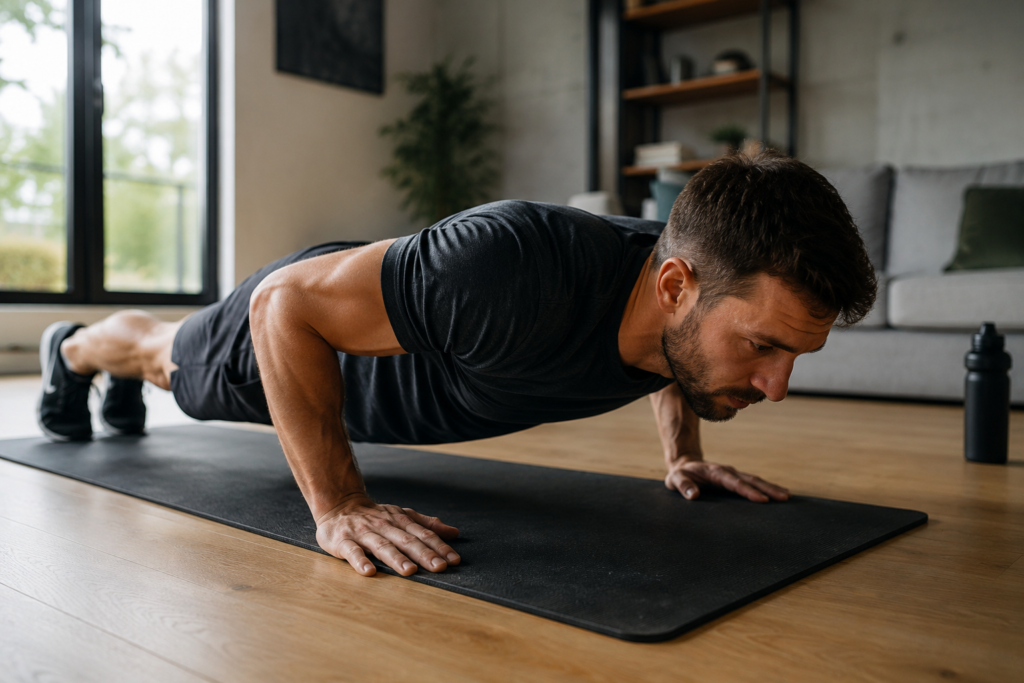
The main muscles doing the work during a push-up are your chest, shoulders and triceps. But that’s not all that’s happening.
If you’re doing them properly, your core has to work to keep your body stable, while your legs, hips and upper back all play a part in keeping you in a solid position.
You’re not just moving your arms. You’re moving your body as one unit.
And the stronger you get, the easier a lot of other physical activities become.
You Can Do Them Almost Anywhere
This is probably my favorite thing about push-ups.
You don’t need a gym.
You don’t need dumbbells.
You don’t need an hour of free time.
If you’ve got enough floor space to lie down, you’ve got everything you need.
At home, in the garden, in a hotel room, before or after your normal workout — push-ups are always available.
That makes them particularly useful when life gets in the way of your normal training.
Can’t make it to the gym today?
Fine. Get on the floor and do something.
They Build Strength AND Endurance
Push-ups can be used in different ways depending on how you train them.
A few difficult repetitions can challenge your strength. Higher-repetition sets can challenge your muscular endurance.
And that’s where things start getting interesting.
Ten push-ups might not sound like much.
Do ten every minute for ten minutes and you’ve just completed 100 push-ups.
That’s a completely different workout.
Try This Simple Push-Up Workout
Here’s a simple routine you can try.
Set a timer for 10 minutes.
At the start of every minute, perform a number of push-ups that you know you can complete with good form.
If you can comfortably do 10, do 10.
That’s 10 push-ups at the start of each minute for 10 minutes:
10 × 10 = 100 push-ups.
You don’t have to do 10, though.
If five is your current limit, do five.
If you can comfortably manage 15, do 15.
The important thing is that you’re not going to failure on the first few minutes and then spending the rest of the workout lying on the floor wondering what the hell happened.
Leave yourself enough time to recover between sets.
The goal is to accumulate good-quality repetitions.
And if you can’t manage 10 minutes yet, start with five minutes and build from there.
That’s how you get stronger — by gradually asking your body to do a little more than it could do before.
Push-Ups Give You an Easy Way to Measure Progress
There’s something satisfying about an exercise where you can easily see improvement.
Maybe you can do five good push-ups today.
A few weeks later, you’re doing ten.
Eventually you’re doing twenty without stopping.
That’s progress you can actually feel.
You don’t need a complicated fitness test or a load of expensive equipment. Your own performance gives you a very simple measurement.
Just don’t sacrifice good form to make the number look better.
I’d rather see someone perform 15 controlled push-ups than 30 ugly repetitions where their hips are sagging, their range of motion has disappeared and they’re basically having a small argument with the floor.
Push-Ups Can Be Made Easier or Harder
You don’t have to start with standard push-ups if you’re not ready for them.
You can begin with an easier variation and gradually work towards full push-ups.
And once standard push-ups become easy, you can make them harder.
You can increase your repetitions, slow down the movement, change your hand position or progress to more demanding variations.
That’s another reason I like them. You can keep the basic movement but continue to challenge yourself.
The Biggest Benefit Might Be Consistency
There’s one more benefit that doesn’t get talked about enough.
Push-ups are easy to do.
And because they’re easy to do, they’re also easy to put off.
“I’ll do them later.”
“Tomorrow.”
“I’m too busy today.”
We’ve all done it.
But building fitness isn’t really about finding the perfect workout. It’s about doing something consistently enough for your body to adapt.
Five minutes of exercise that you actually do is worth considerably more than the perfect one-hour workout that never happens.
Push-ups make it very difficult to come up with an excuse.
You’ve got a floor.
You’ve got your bodyweight.
Get on with it.
How Many Push-Ups Should You Do?
There’s no magic number.
The right number for you depends on your current strength and fitness.
Start where you are and build from there.
If that’s five push-ups, start with five.
If it’s twenty, start with twenty.
And if you want to see how far you can take it, set yourself a bigger target.
That’s exactly the idea behind our 100 Push-Up Challenge.
It’s not about waking up tomorrow and trying to smash out 100 repetitions when you’re currently struggling with ten.
It’s about starting at your level and gradually building the strength and endurance to reach the target.
Want to see if you can reach 100?
Take the 100 Push-Up Challenge →
If you struggle with motivation, check out this article: How to Stay Motivated to Exercise (Even When You Don’t Feel Like It)