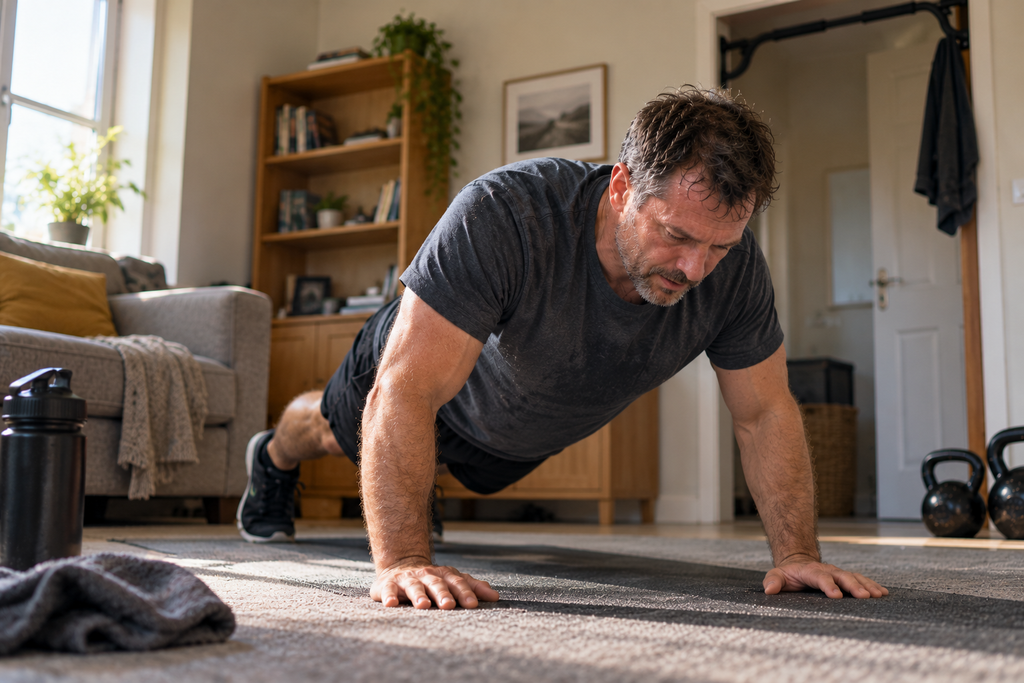
Get More Done in Less Time
A 10-minute workout can be surprisingly effective. You don’t need an hour to get a good workout. You don’t even need half an hour. If you choose the right exercises and put some effort into them, ten minutes can be enough to deliver a seriously demanding session.
The problem is that people often think exercise has to involve a trip to the gym, a complicated program and a big chunk of their day. When they haven’t got the time, they do nothing.
That’s backwards.
Ten minutes is better than nothing and it can be brutally effective. Do it consistently and it can make a worthwhile contribution to your fitness.
The trick is to stop worrying about how long you’re exercising and start thinking about what you’re doing with that time.
Why a 10-Minute Workout Works
A short workout forces you to be economical. You choose your exercises, decide how many repetitions you’re going to perform, set the clock and get on with it.
There’s no need to spend ten minutes deciding what to do or wandering around looking for equipment. You have a plan, and every minute has a purpose.
Of course, ten minutes of exercise isn’t automatically effective. The workload has to be appropriate for your goal. If you’re trying to improve strength and muscular endurance, the exercises need to challenge those qualities. If you’re working on conditioning, you need to put enough effort into the session to challenge your cardiovascular system.
That doesn’t mean going all-out until your technique falls apart. It means working hard enough to make the session count.
You can build strength and endurance with short workouts, particularly if you’re relatively new to training or use the time intelligently as part of a broader program. More experienced athletes may need additional training volume to meet their particular goals.
But if the choice is between ten minutes of purposeful exercise and doing nothing because you haven’t got an hour available, the ten minutes is a pretty good place to start.
EMOM: Every Minute on the Minute
One of my favorite ways to structure a short workout is EMOM, which stands for Every Minute on the Minute.
The principle is simple. At the start of each minute, perform a set number of repetitions. Once you’ve finished, you rest for whatever time remains before the next minute begins.
Let’s say you’re doing eight push-ups every minute for ten minutes. If you finish in 20 seconds, you’ve got 40 seconds to recover. If you take 35 seconds, you’ve got 25 seconds.
Your recovery is whatever remains of the minute. If you need more recovery, reduce the repetitions. That’s the beauty of the format: you can adjust the workload without changing the structure.
You do need to watch the clock, of course. You need to know when the next round starts. The advantage is that the timing is fixed, so you don’t have to make decisions about when to begin each new set.
Here are three ways to use EMOM for a demanding ten-minute workout.
1. Push-Ups and Pull-Ups
This is a straightforward upper-body workout requiring very little equipment beyond a pull-up bar.
At the beginning of every minute, perform:
- 10 push-ups.
- 5 pull-ups.
Repeat for ten rounds.
Complete every repetition and you’ve accumulated 100 push-ups and 50 pull-ups in ten minutes. That’s a considerable amount of work in a short period.
Those numbers are an example, not a requirement. If you can’t manage five pull-ups, reduce the number or use inverted rows as an alternative. For push-ups, elevate your hands on a suitable sturdy surface to make the movement easier.
Keep the repetitions controlled and choose a target that allows you to complete the ten rounds without your technique deteriorating.
As your strength improves, you can increase the repetitions or move towards more demanding variations.
The combination works because you’re training two complementary movement patterns. Push-ups challenge the chest, shoulders and triceps, while pull-ups work the back and elbow flexors. Together, they make an efficient upper-body session.
2. Burpees: A Full-Body Workout
Burpees are brilliant when you want a demanding workout without any equipment. They involve the entire body, combining movements that challenge the upper body, legs and trunk while placing a substantial demand on your cardiovascular system.
For this workout, set a target number of burpees to perform at the beginning of each minute for ten minutes.
You might start with seven or eight per minute and gradually work towards ten as your fitness improves. Ten per minute for ten rounds gives you 100 burpees.
The version you choose matters.
A full burpee can include a push-up when your chest reaches the floor, followed by bringing your feet forward, standing up and jumping vertically. If you want to make the movement more demanding, set yourself a standard for the jump rather than simply going through the motions.
Beginners can simplify it considerably:
- Step your feet back instead of jumping them.
- Leave out the push-up.
- Stand up at the end rather than jumping.
You can introduce the more demanding elements as your fitness improves. You can also adjust the repetitions per minute to make the session harder or easier.
The important thing is to maintain a consistent standard. Don’t start with a number you can manage for one minute but have no chance of sustaining for ten.
Burpees get difficult quickly because you’re repeatedly moving your body between the floor and standing. Add a push-up and a jump to every repetition, and the workload soon adds up.
If you’re short on time and want a challenging full-body conditioning session, they’re hard to beat.
3. Double Kettlebell Clean and Press
If you have kettlebells and know how to use them properly, the double clean and press is another excellent option.
The clean brings both kettlebells into the rack position, close to the upper chest. From there, you press both bells overhead before returning them to the rack, letting them drop between your legs and moving into the next repetition.
In the continuous variation described here, the bells swing between the legs between repetitions without touching the floor.
The clean involves the hips and lower body, while the strict overhead press places a heavy demand on the shoulders and triceps. Your trunk works to stabilize your body throughout the movement.
Repeated for ten minutes with limited recovery, it’s a combination of strength work and conditioning.
How to structure it
Start each minute with a target of say, six clean-and-press repetitions. Rest for the remainder of the minute, then repeat when the next minute begins.
Six repetitions is an example. Depending on your strength and experience, you might need fewer repetitions or lighter kettlebells.
As fatigue builds, reduce the repetitions if necessary to maintain good technique or use a bounce in the legs to make the press easier. Don’t force the target at the expense of control.
Making it easier
The obvious starting point is lighter kettlebells. You can also reduce the repetitions per minute.
Another option is the push press, which uses leg drive to help move the kettlebells overhead. This is different from a strict press, where the legs remain still during the pressing phase.
If you’re new to kettlebells, learn the clean and press with a manageable weight before trying to maintain a demanding pace against the clock. Technique matters, particularly when you’re handling two weights overhead.
EMOM Isn’t the Only Option
EMOM is useful because it gives you a clear target and a fixed interval. But it’s only one way to organize a short workout.
Another option is AMRAP: As Many Rounds or Repetitions as Possible.
With AMRAP, you set a time limit and complete as much quality work as you can within it.
For example, you could set a ten-minute timer and cycle through a series of exercises, such as push-ups, squats and mountain climbers. Complete the prescribed repetitions for each exercise, then repeat the sequence until time runs out.
You can record how many rounds you finish and use that as a reference when you repeat the workout.
The difference is straightforward. With EMOM, you begin a prescribed set at the start of every minute. With AMRAP, you work through a sequence at your own pace until the timer expires.
Neither is automatically better. Choose the format that suits the exercises and the training effect you’re after.
Make Ten Minutes Your Minimum
One of the biggest advantages of a short workout is that it’s easier to fit into your day.
You don’t need to travel to a gym or wait until you’ve got a completely free hour. You can train at home with bodyweight exercises, or use a couple of kettlebells if you have them.
Decide on the workout beforehand. Know your repetitions, set the timer and get started.
If you have more time available, you can train for longer. If ten minutes is all you’ve got, use those ten minutes efficiently.
You can also track your progress without making it complicated. Record the repetitions, rounds and weights you use. Over time, you might complete more repetitions, maintain better technique or find the same workload easier to manage.
Don’t feel that you have to increase the workload every session. Consistent training matters more than constantly trying to beat your previous performance.
And remember that ten minutes doesn’t have to be your entire fitness program. You may need additional training, regular walking, cardiovascular exercise and recovery depending on your goals. A short, demanding workout is one useful tool, not a magic replacement for everything else.
If you’re a beginner, start with manageable variations and build gradually. If you have an injury or a medical condition that affects your ability to exercise, choose appropriate movements and seek professional advice when needed.
Stop Waiting for an Hour You Haven’t Got
You can spend weeks searching for the perfect program, buying equipment and waiting for life to become less busy.
Or you can set a timer and get moving.
Choose exercises that suit your ability. Set a sensible target. Work hard enough to challenge yourself, and maintain good technique throughout the session.
Ten minutes won’t solve every fitness problem, and not every workout needs to be brutal. But a well-planned ten-minute session can be a worthwhile part of building strength, endurance and conditioning.
The next time you think you haven’t got time to exercise, ask yourself whether you can find ten minutes.
You probably can.
You don’t need an hour to get started. You need a plan, ten minutes and the willingness to do the work.