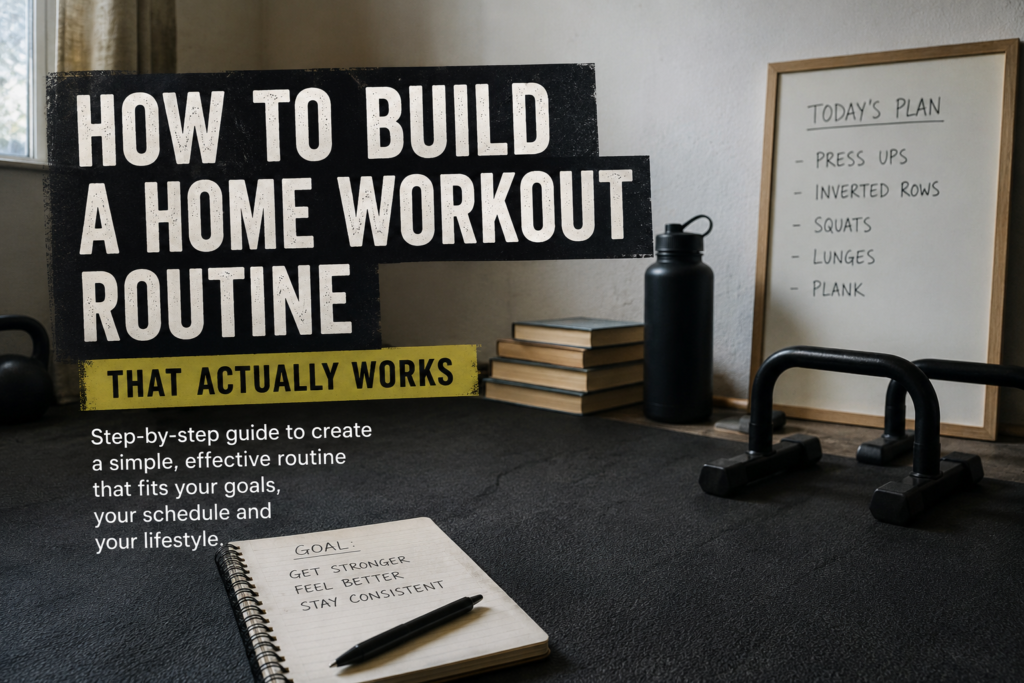
Introduction
Home workouts have never been more popular. Whether you’re trying to lose weight, build strength, improve your fitness or simply become more active, training at home can be every bit as effective as joining a gym.
The problem isn’t a lack of equipment—it’s a lack of structure.
Many people start with good intentions, following random YouTube workouts, downloading fitness apps or trying the latest social media challenge. A few weeks later they’re frustrated because they aren’t seeing the results they expected.
An effective home workout routine doesn’t have to be complicated. In fact, the best programmes are usually built around a handful of proven exercises, performed consistently and progressed over time.
In this guide, you’ll learn how to build a home workout routine that matches your goals, fits your schedule and helps you make steady progress without expensive equipment or complicated training methods.
Start With One Clear Goal
Before choosing a single exercise, decide exactly what you’re trying to achieve.
Different goals require different approaches, and trying to chase everything at once usually leads to disappointment.
Ask yourself:
- Do I want to lose body fat?
- Do I want to build muscle?
- Do I want to get stronger?
- Do I want to improve my overall fitness?
- Am I simply trying to become healthier and more active?
Once you’ve identified your primary goal, every decision becomes easier. You’ll know how often to train, which exercises deserve your attention and how to measure your progress.
Remember, your goal doesn’t have to stay the same forever. You can always adjust your routine as your fitness improves. What matters is having a clear direction from the beginning.
Choose the Right Exercises
One of the biggest mistakes people make when building a home workout routine is believing they need dozens of different exercises.
They don’t.
A better routine isn’t created by adding more variety. It’s created by choosing exercises that train the whole body and getting progressively better at them over time.
Think of your workout like building a house. You don’t start with the decorations—you build strong foundations first. The same principle applies to exercise.
Instead of trying to include every movement you’ve seen on YouTube or social media, focus on five fundamental movement patterns:
Push
These exercises strengthen your chest, shoulders and triceps.
Examples include:
- Push-ups
- Incline push-ups
- Chair dips
- Pike push-ups
Pull
Pulling exercises develop your back, biceps and grip strength while helping to improve posture.
Examples include:
- Pull-ups (overhand grip)
- Inverted rows
- Resistance band rows
- Chin-ups (underhand grip)
Squat
Squatting movements build strength throughout your legs and improve everyday mobility.
Examples include:
- Bodyweight squats
- Split squats
- Lunges
- Step-ups
Hinge
Hinging trains the muscles on the back of your body, including your glutes, hamstrings and lower back—areas that are often neglected in home workouts.
Examples include:
- Glute bridges
- Hip thrusts
- Single-leg Romanian deadlifts
- Supermans
Core
Your core transfers force between your upper and lower body and helps keep your spine stable during almost every movement you perform.
Examples include:
- Planks
- Side planks
- Crunches
- Sit-ups
If your weekly routine includes exercises from each of these five movement patterns, you’ll train your entire body without making your workouts unnecessarily complicated.
Remember: effective programmes are built on mastering the basics, not constantly searching for new exercises.
How Many Exercises Do You Need?
One of the biggest reasons people give up on home workouts is because they make their routines too complicated.
They try to include every exercise they know, train every muscle from every angle, and end up with workouts that last well over an hour. Before long, motivation disappears and the routine is abandoned.
The truth is that you don’t need twenty different exercises to get fit.
A simple routine built around six to eight well-chosen exercises is more than enough for most people. As long as those exercises train your upper body, lower body, and core, you’ll build strength, improve fitness, and make consistent progress.
For example, a beginner full-body workout could include:
- Press Ups
- Bodyweight Squats
- Inverted Rows
- Lunges
- Plank
- Burpees
Each exercise has a purpose, and together they train the entire body without wasting time.
As you become stronger, there’s no need to completely replace your routine. Instead, make the exercises more challenging, increase the number of repetitions, add another set, or reduce your rest periods.
Remember, progress comes from improving the basics—not constantly changing them.
Sets, Repetitions and Rest Periods
One of the most common questions beginners ask is, “How many sets and repetitions should I do?”
The answer depends on your goal, but for most people the exact numbers are far less important than training consistently and using good technique.
If you’re new to bodyweight training, start with 2 to 3 sets of each exercise. Choose a number of repetitions that challenges you while still allowing you to maintain proper form throughout the set.
For some exercises, that might mean:
- 8–15 Press Ups
- 10–20 Bodyweight Squats
- 5–10 Inverted Rows
- 20–40 second Plank
Everyone starts at a different level. One person may struggle to perform five press ups, while another can comfortably complete twenty. Focus on improving your own performance rather than comparing yourself to others.
Rest periods should also match the type of workout you’re performing.
If your goal is to build strength, resting 60 to 90 seconds between sets allows you to recover enough to perform the next set with good technique.
If you’re performing a conditioning circuit, shorter rest periods help keep the heart rate elevated and increase the overall training effect.
The most important principle is progression. Once you can complete all your planned repetitions comfortably with good form, it’s time to make the exercise more demanding. That might mean performing an extra repetition, adding another set, progressing to a more difficult variation, or reducing your rest periods slightly.
Small improvements made consistently over time produce far better results than constantly changing your workout.
Build a Weekly Training Schedule
The best workout routine in the world won’t produce results if you can’t stick to it.
One of the biggest mistakes beginners make is trying to train every day. They start with plenty of enthusiasm, but after a week or two they’re exhausted, sore and struggling to stay motivated.
A better approach is to build a routine that fits your life.
For most beginners, three full-body workouts each week is an excellent starting point. Training on Monday, Wednesday and Friday, for example, gives your body time to recover while allowing you to practise the exercises often enough to make steady progress.
On the days between your workouts, you don’t have to do nothing. A brisk walk, a gentle bike ride or some mobility work can help you stay active without interfering with recovery.
As your fitness improves, you can gradually increase your training volume. Some people add a fourth workout each week, while others include a short conditioning session or an extra day to focus on a weaker area.
The important thing is to increase your workload gradually. Your body needs time to adapt, and trying to do too much too soon often leads to fatigue, injury or simply giving up altogether.
Choose a schedule you know you can follow. A routine you complete every week will always produce better results than the perfect programme that you abandon after ten days.
Progress Is Built One Step at a Time
The human body is remarkably good at adapting.
If you perform the same workout with the same effort every week, your body eventually becomes efficient at it. Once that happens, progress begins to slow.
The solution isn’t to throw away your routine and start again. It’s to give your body a new challenge.
That challenge can be surprisingly small.
You might:
- Perform one extra repetition.
- Add another set.
- Reduce your rest periods slightly.
- Progress to a more challenging variation of an exercise.
- Complete the same workout with better technique than before.
- Slow the movements down.
These small improvements may not seem significant on their own, but they add up over weeks and months.
For example, imagine you can perform eight good-quality press ups today. If you work consistently until you can perform fifteen, you’ve almost doubled your strength and endurance without changing the exercise.
The same principle applies to squats, pull ups, planks and almost every other bodyweight exercise.
Many people never see the results they want because they keep searching for a new workout instead of improving the one they’re already doing.
Success doesn’t come from constantly changing your programme. It comes from becoming better at the fundamentals.
Instead of asking yourself, “What workout should I do next?”, ask a different question:
“How can I perform today’s workout just a little better than last week’s?”
That simple mindset will take you much further than constantly chasing the latest fitness trend.
Common Mistakes That Hold People Back
Building an effective home workout routine isn’t complicated, but there are a few common mistakes that can slow your progress or stop it altogether.
Doing Too Much Too Soon
Motivation is highest when you first decide to get fit, which is why many beginners try to train every day.
Unfortunately, your enthusiasm usually outpaces your body’s ability to recover.
Start with a realistic schedule and increase your training gradually. Consistency over several months will always produce better results than a week of all-out effort followed by burnout.
Changing Your Routine Every Week
It’s easy to believe that a new workout is the answer whenever progress slows.
In reality, constantly switching exercises makes it difficult to measure improvement. Give your routine time to work before making major changes.
Ignoring Recovery
Your body doesn’t become stronger during a workout—it adapts afterwards.
Recovery is just as important as training. Getting enough sleep, eating a balanced diet and allowing your muscles time to recover all contribute to better long-term results.
Focusing on Quantity Instead of Quality
Twenty poorly performed press ups are far less valuable than ten performed with good technique.
Always prioritise controlled movement and proper form over rushing through repetitions.
Expecting Instant Results
Real fitness takes time.
You won’t transform your body in two weeks, but if you continue training consistently, you’ll be surprised how much stronger and fitter you become over the course of a few months.
The people who achieve lasting results aren’t usually the most talented—they’re the ones who keep showing up, even when progress feels slow.
A Simple Beginner Home Workout Routine
Now that you understand the principles behind building an effective home workout routine, here’s a simple full-body programme you can use as a starting point.
Perform this workout three times each week, leaving at least one day of rest between sessions.
| Exercise | Sets | Repetitions |
| Press-ups | 2–3 | 8-15 |
| Inverted Rows | 2–3 | 8-15 |
| Bodyweight Squats | 2–3 | 10-20 |
| Lunges | 2–3 | 8-12 (each side) |
| Plank | 2–3 | 20-60 seconds |
| Burpees (optional finisher) | 2–3 | 10-15 |
If you can’t yet complete the suggested number of repetitions, don’t worry. Choose an easier variation or perform as many quality repetitions as you can. As your strength improves, gradually work towards the recommended range.
Before each workout, spend five to ten minutes warming up with light movement and some joint mobility exercises. Afterwards, take a few minutes to cool down and stretch the muscles you’ve just trained.
There’s no need to rush your progress. Focus on performing every repetition with good technique, and aim to improve just a little each week. That might mean one extra repetition, an additional set, or simply completing the workout with better control than last time.
Remember, this routine isn’t designed to leave you exhausted every time you train. Its purpose is to help you build a solid foundation that you can stick to for months rather than days.
The best workout routine isn’t the most complicated one or the one that promises the fastest results. It’s the one you’ll still be following three months from now.
Conclusion
Building an effective home workout routine doesn’t require an expensive gym membership, complicated equipment or a different workout every week.
What it does require is a clear goal, a handful of effective exercises and the patience to improve a little at a time.
If you focus on the fundamentals, train consistently and gradually challenge yourself, you’ll build strength, improve your fitness and create habits that last far longer than the latest fitness trend.
Remember, there isn’t one perfect workout routine. The best routine is the one that fits your current ability, works with your lifestyle and keeps you coming back week after week.
Start simple. Master the basics. Stay consistent.
Those principles have helped countless people build stronger, healthier bodies, and they’ll work just as well for you.
If you’ve found this guide helpful and you’re ready to take your training further, the Commando Fitness Bodyweight Manual expands on these principles with a complete bodyweight training system. It includes a wider range of exercises, progressive training plans, conditioning workouts and guidance to help you continue to improve.
Whether you use the routine in this article or move on to a more structured programme, the important thing is to begin. Your future fitness won’t be determined by the workout you planned to start—it will be built by the one you actually do.
Before You Start
Before beginning any new exercise programme, it’s a good idea to consult your doctor or another qualified healthcare professional, especially if you have a medical condition, are pregnant, have been inactive for a long period, or have any concerns about your ability to exercise safely.
Exercise should be challenging, but it should never cause severe pain or make an existing injury worse. If you experience chest pain, dizziness, or any other concerning symptoms during exercise, stop immediately and seek medical advice.
For general recommendations on how much physical activity adults should aim for each week, see the World Health Organization’s Physical Activity Guidelines.
if motivation is a problem, check out our article on: How-to-stay-motivated-to-exercise