Introduction
Learning how to prepare mentally for any physical challenge begins long before the challenge itself.
Whether you’re preparing for your first 5K, stepping onto a Brazilian Jiu-Jitsu mat, entering a boxing ring, taking on an obstacle course, climbing a mountain, or attempting your first endurance event, one thing is certain: your body won’t be the first thing that tries to stop you.
Your mind will.
Long before your muscles give out, your brain will start looking for reasons to slow down, take a break, or quit altogether. It will tell you you’re too tired, that you’ve done enough, or that you can always try again another day. This isn’t weakness—it’s human nature. Your brain is designed to conserve energy and protect you from discomfort.
The problem is that growth rarely happens inside your comfort zone.
The athletes, martial artists, hikers, runners, and everyday people who consistently achieve difficult goals aren’t necessarily the strongest or the fastest. More often than not, they’re simply better prepared for the conversation that takes place inside their own heads when things become difficult.
The good news is that mental toughness isn’t something you’re born with. Like strength, endurance, or fitness, it can be developed through deliberate practice. The work begins long before the starting line, and it often has very little to do with the event itself.
In this article, you’ll learn practical ways to prepare your mind for any physical challenge so that when discomfort arrives—as it always does—you’ll be ready for it.
Accept That Discomfort Is Part of the Process
One of the biggest mistakes people make is expecting a difficult challenge to somehow feel easy.
They hope they won’t get nervous before the event.
They hope the hill won’t feel as steep as they imagined.
They hope the last few miles won’t hurt.
Then, when those feelings inevitably arrive, they think something has gone wrong.
Nothing has gone wrong.
Discomfort is part of the process.
Every worthwhile physical challenge comes with moments of doubt, fatigue, frustration, and discomfort. If you expect those moments, they lose much of their power over you. Instead of thinking, “This shouldn’t be happening,” you recognise it for what it is—a normal part of doing something difficult.
This simple shift in mindset can make an enormous difference. You stop fighting the discomfort and start working through it.
Accepting that things will get hard doesn’t make you pessimistic. It makes you prepared.
As the saying goes, smooth seas never made a skilled sailor.
The same is true of physical challenges. The difficult moments are often the very moments that help you grow.
Accept That Nervousness Is Normal
If you’ve ever stood at the start of a race, waited to step onto a Brazilian Jiu-Jitsu mat, climbed into a boxing ring, or prepared for any competition, you’ve probably experienced it.
Your heart starts beating faster.
Your mouth feels dry.
Your stomach is in knots.
You begin questioning whether you’re really ready.
I’ve experienced these feelings countless times before martial arts competitions, and over the years I’ve learned something important: nervousness isn’t the enemy.
In fact, it’s exactly what you’d expect.
Your body is preparing you for a challenge. Your heart rate increases, adrenaline begins flowing, and your senses become sharper. These are the same physical responses that help you perform at your best. The goal isn’t to eliminate those feelings—it’s to stop interpreting them as a sign that something is wrong.
One idea that helped me enormously came from reading Geoff Thompson´s Watch My Back years ago while I was competing in judo tournaments. He pointed out something that’s easy to forget when you’re standing there feeling nervous:
Your opponent is feeling exactly the same way.
They’re wondering if they’ve trained enough.
They’re feeling the same butterflies.
They’re trying to manage the same doubts.
Remembering this helped me stop seeing nervousness as a personal weakness. It reminded me that these feelings are simply part of competition.
When I notice those nerves building now, I don’t fight them. Instead, I focus on slowing everything down.
A few minutes of deliberate breathing through my nose helps lower my heart rate and gives me something positive to focus on. Sometimes I’ll use box breathing—inhaling, holding, exhaling, and holding again for equal counts. Other times, I simply take slow, controlled breaths and try to quieten my mind.
Almost like a form of Zen.
The aim isn’t to empty your mind completely. It’s to stop it racing ahead to every possible outcome and bring your attention back to the present moment.
The challenge hasn’t started yet.
There’s nothing to solve except the next breath.
When the moment finally arrives, you’re calmer, more focused, and ready to perform.
Train Your Mind Before You Train Your Body
Most people think visualization means imagining yourself standing on the podium, crossing the finish line, or having your hand raised in victory.
There’s nothing wrong with that, but I think mental preparation can go much deeper.
One habit I’ve developed over the years is mentally rehearsing when I’m lying in bed—either before I go to sleep or during those quiet minutes after I wake up. It’s become part of my training routine, just as much as lifting weights, running, or spending time on the mats.
If I’m preparing for a Brazilian Jiu-Jitsu competition, I don’t simply picture myself winning the match. I mentally work through the techniques I’ve been practising. I’ll replay rounds from training, think about what my opponent did, where I made mistakes, and how I could respond differently if the same situation happened again.
Sometimes I’ll repeat the same techniques over and over again in my mind, refining every small detail. Other times, something completely unexpected appears—a different grip, a new angle, or a counter I’d never considered before. Occasionally, something just clicks. and I think, “That’s it… I’ll have to try that next time.”
Not every idea works, of course, but many of them have. Some of the improvements I’ve made on the mats first appeared during these quiet mental rehearsals rather than during physical training.
I use exactly the same approach for difficult workouts.
If I’ve planned a demanding kettlebell session—perhaps six clean and press repetitions every minute for ten minutes—I’ll sometimes rehearse the entire workout in my mind. I imagine picking up the kettlebells for the first set, putting them down, controlling my breathing, watching the seconds tick away, and starting again when the next minute begins.
I picture all ten sets.
I imagine how the workout will feel as fatigue builds, how tempting it will be to stop, and how I’ll respond when my mind starts looking for excuses. By the time I attempt the session for real, I’ve often completed it several times in my head.
Interestingly, I’ve sometimes mentally rehearsed workouts before I’d ever managed to complete them physically.
That might sound strange, but I’ve found it incredibly useful. When I finally attempt the workout, it doesn’t feel completely unfamiliar because, in a sense, I’ve already been there.
If I’m preparing for a competition, I don’t wait until the night before to start thinking about it. I’ve usually rehearsed it dozens of times long before I step onto the mat, stand at the start line, or hear the bell.
Mental preparation isn’t something I switch on the day before. It’s part of the training itself.
Whether you’re preparing for a marathon, a charity walk, a boxing match, an obstacle race, or your first fitness challenge, don’t just train your body.
When the challenge finally arrives, it shouldn’t feel like the first time you’ve faced it. Your body may be experiencing it for the first time, but your mind has already been there dozens of times.
Focus on the Next Step, Not the Finish Line
One of the quickest ways to become overwhelmed is to think about everything that’s still ahead of you.
If you’re twenty miles into a marathon and all you can think about is the six miles you’ve still got to run, the finish line can feel impossibly far away.
If you’re halfway through a tough hike and you’re constantly looking up at the mountain still to climb, it’s easy to become discouraged.
The same is true in a martial arts match. If you’re worrying about winning the whole contest instead of dealing with what’s happening right now, your attention drifts away from the only moment you can actually influence.
I’ve found it far more effective to break any challenge down into small, manageable pieces.
Don’t think about the next ten miles.
Think about the next mile.
Don’t think about the next hour.
Think about the next minute.
Don’t think about finishing all ten sets of your workout.
Just complete the set you’re doing now.
Then do the next one.
When I was serving in the Royal Marines, long marches and physically demanding exercises were never completed by thinking about the finish line from the very beginning. You focused on reaching the next checkpoint, the next feature on the horizon, or simply putting one foot in front of the other. Eventually, those small victories added up to completing the whole task.
The same principle applies to almost every physical challenge you’ll ever face.
Large goals can feel intimidating.
Small goals feel achievable.
And every time you achieve one, your confidence grows.
Before long, you’ve covered a distance that once seemed impossible—not because you obsessed over the destination, but because you kept concentrating on what needed to happen next.
When your mind starts telling you how far you’ve still got to go, gently bring your attention back to the present.
Ask yourself a simple question:
“What’s the next thing I need to do?”
Then do it.
And when that’s finished…
Do the next thing.
One step.
One repetition.
One breath.
One decision at a time.
Get Comfortable Being Uncomfortable
If there’s one lesson that’s shaped my approach to training—and life—more than any other, it’s this:
Don’t avoid discomfort. Learn to become comfortable with it.
We live in a world that’s designed to make life as comfortable as possible. We can order food without leaving the house, binge-watch television for hours, scroll endlessly through social media, and avoid anything that feels difficult or inconvenient.
There’s nothing wrong with comfort in itself. The problem comes when comfort becomes the default setting for everything we do.
Growth rarely happens there.
Every worthwhile goal requires us to do things we’d often rather avoid.
Getting out of bed when it’s warm and comfortable.
Training when motivation has disappeared.
Going for a run when it’s cold, wet, or windy.
Choosing a healthy meal instead of the easy option.
Finishing one more repetition when every part of you wants to stop.
These moments might seem small, but they all have one thing in common.
They’re opportunities to strengthen your mind.
One habit I’ve adopted over the years is deliberately choosing small amounts of discomfort every day. Sometimes it’s taking a cold shower. Other times it’s getting up early when I’d rather stay in bed, sticking to my training plan when I don’t feel like it, or simply doing the difficult task first instead of putting it off.
None of these things are particularly enjoyable in the moment.
That’s the point.
Every time you choose discipline over comfort, you’re teaching yourself an important lesson:
You don’t have to obey every feeling.
Just because you don’t feel like doing something doesn’t mean you shouldn’t do it.
In fact, some of the most worthwhile things you’ll ever do will begin with the thought, “I really can’t be bothered today.”
The more often you ignore that voice and take action anyway, the weaker it becomes.
Eventually, doing difficult things starts to feel normal.
That doesn’t mean they become easy.
It means you’ve changed your relationship with discomfort.
Instead of seeing it as something to avoid, you begin to recognise it as a sign that you’re growing.
I’ve found that this mindset carries over into every physical challenge.
When fatigue sets in during a long workout, it doesn’t come as a surprise because you’ve practised dealing with discomfort.
When your mind starts suggesting you slow down or quit, you’ve already spent months proving to yourself that feelings don’t have to dictate your actions.
Mental toughness isn’t built during the biggest moments of your life.
It’s built in the ordinary moments that nobody else sees.
The alarm clock that goes off before sunrise.
The cold shower when a hot one would feel much better.
The workout you complete even though nobody would know if you skipped it.
The decision to keep going when stopping would be easier.
Those small choices accumulate over time.
They become habits.
Those habits become character.
And when a genuinely difficult challenge finally arrives, you’re no longer relying on motivation to carry you through.
You’ve spent months—or even years—training your mind to do hard things.
Because of that, when your body starts asking questions, your mind already knows the answer.
When Your Body Starts Asking Questions
When Your Body Starts Asking Questions
For me, one example is a heavy set of 20 kettlebell squats.
The first ten repetitions are comfortable enough. My breathing is steady, the kettlebells feel manageable, and I know there’s plenty left in the tank.
By fifteen repetitions, everything starts to change.
It isn’t my legs that are failing.
It’s my engine.
My heart is pounding.
My breathing becomes heavier with every repetition.
I can feel my cardiovascular system struggling to keep up with the demands I’m placing on it. The kettlebells haven’t suddenly become heavier, but my whole body begins to feel physically weaker because I’m running out of oxygen and energy.
By the final four repetitions, I’m completely spent.
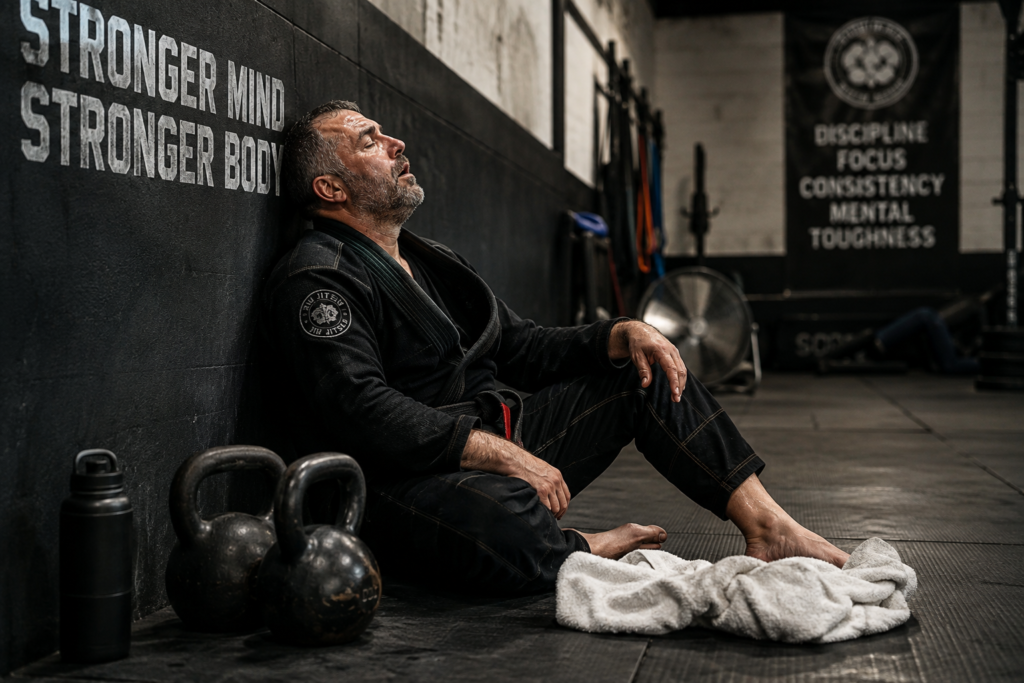
When I finally put the kettlebells down, there’s no standing around admiring the effort. I usually collapse onto the bed or the nearest chair, with a towel already laid out because I know exactly what’s coming. I’m gasping for air, my heart pounding in my chest, and for a minute or two I’m good for absolutely nothing except trying to recover.
I’ve experienced exactly the same feeling after hard rounds of Brazilian Jiu-Jitsu. It isn’t usually my muscles that make me want to stop. It’s the feeling that my heart and lungs simply can’t keep up. My whole body feels drained, and all I want to do is lie there until my breathing settles again.
Of course, improving your fitness helps. At fifty-six, I know my cardiovascular engine isn’t what it was when I was twenty-six. That’s simply part of getting older, and it’s something I accept. But whatever your age or fitness level, there comes a point where every hard effort becomes a conversation between your body and your mind.
Mental strength doesn’t suddenly give you a bigger engine.
It doesn’t magically put more oxygen into your lungs.
It doesn’t make the workout any easier.
What it does is stop you quitting before you’ve genuinely reached your limit.
Sometimes there’s still one more repetition.
One more step.
One more effort.
I’ve found that reminding myself why I’m doing something often provides the answer.
Maybe I’m training for a competition.
Maybe I’m trying to become a better version of myself.
Maybe I’m simply refusing to become someone who quits the moment things become uncomfortable.
Your reason doesn’t have to impress anyone else.
It just has to matter to you.
My reason is Brazilian Jiu-Jitsu. When the kettlebells become difficult, I remind myself that if I were in the middle of a match, I couldn’t ask my opponent for a little breather. I have to keep working until the round is over. That thought is often enough to find one or two more repetitions.
When your purpose is strong enough, it becomes an anchor during the difficult moments. It gives you something to hold onto when motivation has disappeared and discomfort is trying to convince you that stopping is the sensible option.
The people who achieve difficult things aren’t always the strongest, the fastest, or the most naturally talented.
More often, they’re the people who keep moving long after the excitement has faded.
They remember why they started.
And then they take one more step.
One more repetition.
One more breath.
Conclusion
Every physical challenge is different.
Some last a few minutes. Others last for hours. Some take place on a running track, others on a mountain, a Brazilian Jiu-Jitsu mat, inside a boxing ring, or in the gym.
But they all have one thing in common.
At some point, your mind will start asking questions.
It will look for reasons to slow down, take a break, or convince you that you’ve done enough.
The difference between finishing and giving up often isn’t talent or fitness alone. More often than not, it’s how well you’ve prepared for that conversation before it ever begins.
Mental toughness isn’t built on race day.
It isn’t built during a competition.
It isn’t something you suddenly discover halfway through a brutal workout.
It’s built every time you choose discipline over comfort.
Every time you get out of bed when you don’t feel like it.
Every cold shower.
Every workout you complete despite a lack of motivation.
Every difficult conversation you don’t avoid.
Every promise you keep to yourself.
Those small decisions might seem insignificant at the time, but together they build the habits and resilience that carry you through life’s biggest challenges.
When the next physical challenge arrives, your body may be experiencing it for the first time.
But if you’ve prepared your mind well, it won’t.
Because mental preparation isn’t something you switch on the day before. It’s part of the training itself.
Build Your Mental Strength
If this article resonated with you, you’ll probably enjoy 7 Questions That Build Mental Strength.
It’s not a book of motivational quotes or quick fixes. It’s a practical guided journal designed to help you develop the habits, discipline, resilience, and self-belief needed to face life’s challenges with confidence.
Whether you’re preparing for a race, a martial arts competition, a fitness goal, or simply want to become more disciplined in everyday life, it will help you build the mindset that supports lasting progress.
A stronger body is built one workout at a time.
A stronger mind is built one decision at a time.
Mental preparation gets you ready for the challenge. Consistent training gets you to the start line. If you’re struggling to stay motivated, read our article, How to Stay Motivated to Exercise.