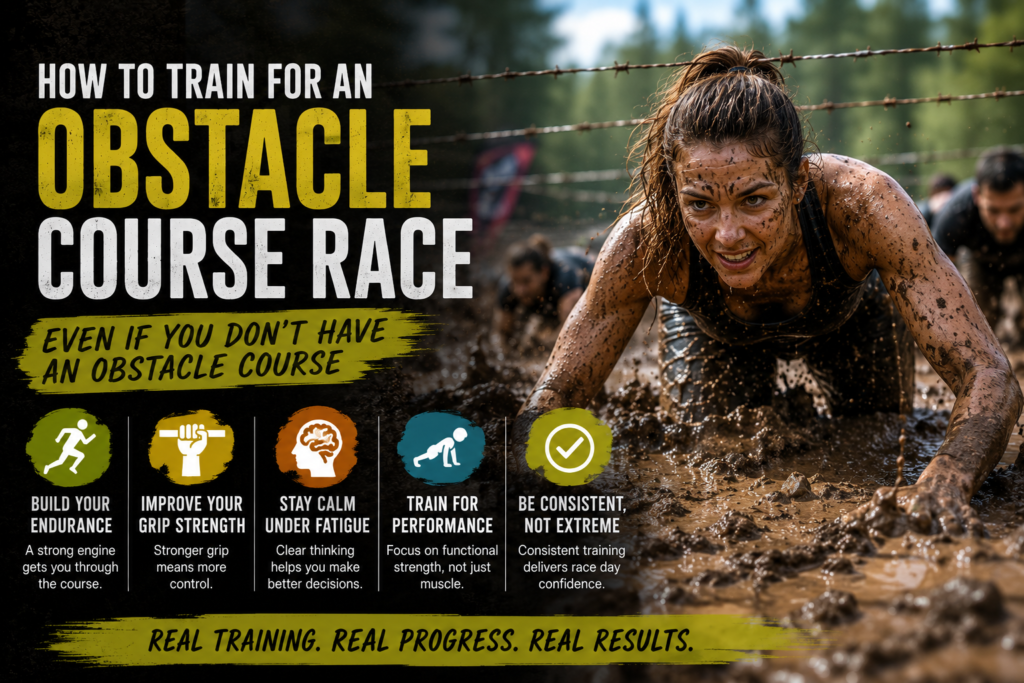
Introduction
Learning how to train for an obstacle course race doesn’t require access to ropes, mud pits or monkey bars.
The truth is, those obstacles are only a small part of the challenge.
What usually determines whether you finish strong—or end up exhausted halfway through—is your overall fitness. Obstacle course races demand endurance, strength, grip, balance, and the ability to keep moving when your body is begging you to stop.
The good news is that you don’t need access to an obstacle course to develop those qualities.
With the right approach, you can prepare almost anywhere using simple exercises and consistent training.
Let’s look at the qualities that matter most.
Build an Engine Before You Worry About Obstacles
This is where most beginners get it wrong.
People become obsessed with practising obstacles when they can’t comfortably run five kilometres without stopping.
In reality, obstacle course races are usually won and lost between the obstacles, not on them.
Running forms the foundation of almost every OCR event. You’ll spend far more time moving between obstacles than climbing over them, so your cardiovascular fitness needs to be your first priority.
That doesn’t mean every run has to be fast. A mixture of steady runs, hill sessions, and occasional interval training will prepare you far better than trying to sprint every workout.
If you can keep moving comfortably while others are stopping to catch their breath, you’ll already have a huge advantage before the next obstacle even appears.
Grip Strength Is Your Secret Weapon
One of the biggest surprises for first-time obstacle course racers is how quickly their grip gives out.
Your legs might still feel fresh. Your lungs might still have plenty left in the tank. But if your hands can no longer hold onto a rope, monkey bars, or a hanging obstacle, your race can come to a frustrating halt.
Grip strength is often the weak link because it’s something most people rarely train directly.
Fortunately, it doesn’t require expensive equipment.
Pull-ups are one of the best exercises you can do because they strengthen not only your back and arms but also the muscles in your hands and forearms. If you can’t perform a full pull-up yet, don’t let that discourage you. Assisted pull-ups, negative repetitions, and body rows are all excellent ways to build the strength needed to progress.
You can also challenge your grip by hanging from a pull-up bar for as long as possible or by wrapping a towel around the bar before performing pull-ups. The thicker, less stable grip forces your hands and forearms to work much harder, helping to prepare you for ropes, carries, and hanging obstacles.
Remember, obstacle races don’t test how much you can lift once. They test how well you can keep holding on after you’ve already been running for several kilometres.
The stronger your grip becomes, the more energy you’ll save—and the more confidence you’ll have when you reach the next obstacle.
Learn to Stay Calm When You’re Tired
Here’s something many first-time obstacle course racers don’t expect.
The hardest part of an obstacle isn’t always the obstacle itself.
It’s arriving at it out of breath.
After a long run, a steep hill, or a series of demanding obstacles, your heart rate is elevated, your breathing is heavy, and it’s tempting to rush straight into the next challenge.
That’s often when mistakes happen.
A missed grip.
A poor foot placement.
An unnecessary burst of energy.
Experienced racers understand that a few seconds spent regaining control can save minutes later in the race.
Instead of attacking every obstacle at full speed, take a deep breath, assess what you’re about to do, and move with purpose rather than panic.
This is one of the reasons obstacle course racing is as much a mental challenge as a physical one.
Anyone can perform well when they’re fresh.
The real test is making good decisions when you’re fatigued.
You can train this skill before race day.
Include workouts that combine running with bodyweight exercises such as burpees, pull-ups, squats, and press-ups. These sessions teach you to think clearly and maintain good technique while you’re tired—the same situation you’ll face during an obstacle course race.
The goal isn’t simply to become fitter.
It’s to become comfortable being uncomfortable.
That’s often the difference between someone who enjoys the experience and someone who spends the entire race fighting against it.
Train for Performance, Not Just Muscle
One of the biggest misconceptions about obstacle course racing is that bigger muscles automatically make you a better competitor.
They don’t.
Some of the strongest people in the gym struggle on obstacle courses because they’re carrying muscle that doesn’t contribute much to endurance. Meanwhile, smaller athletes with excellent fitness often fly through the course because they can run efficiently, climb confidently, and recover quickly between obstacles.
Obstacle course racing rewards functional strength.
That means training your body to move well rather than simply lifting the heaviest weight possible.
Bodyweight exercises are particularly valuable because they teach you to control your own body under fatigue. Pull-ups develop the pulling strength needed for ropes and walls. Press-ups build upper-body endurance. Squats strengthen the legs for climbs, carries, and uneven terrain. Burpees improve whole-body conditioning while forcing you to work when your heart rate is already high.
That doesn’t mean you should avoid weights altogether. Exercises such as deadlifts, lunges, and overhead presses can all be useful additions to your training. The key is remembering that strength is only one piece of the puzzle.
The best obstacle course racers don’t train to look impressive in the gym.
They train to perform when the course demands it.
When planning your workouts, ask yourself a simple question:
“Will this help me move better on race day?”
If the answer is yes, it deserves a place in your programme.
Don’t Make Race Day Your Hardest Workout
It’s easy to get caught up in the excitement of an upcoming obstacle course race.
Many first-time competitors train hard for a few weeks, enter the event, and hope determination will carry them through.
Sometimes it does.
More often, they discover that enthusiasm can’t replace preparation.
The athletes who perform best aren’t usually the ones who trained the hardest for a week. They’re the ones who trained consistently for months. Fitness is built gradually.
Your running improves one session at a time.
Your grip gets stronger one workout at a time.
Your confidence grows every time you complete a session that once felt difficult.
There’s no shortcut for that process.
It’s far better to complete three or four well-planned training sessions every week for several months than to train every day until you’re exhausted and then lose motivation altogether.
Remember, your goal isn’t to survive race day.
Your goal is to arrive at the start line knowing you’ve already done the hard work.
When that starting horn sounds, you shouldn’t be wondering whether you’re fit enough.
You should be looking forward to proving it.
Final Thoughts
Obstacle course racing isn’t just about climbing walls or crawling through mud.
It’s about combining endurance, strength, grip, resilience, and the determination to keep moving when you’re tired.
The good news is that every one of those qualities can be trained without access to a specialised obstacle course.
Build your running base. Strengthen your grip. Develop functional strength. Learn to stay calm under fatigue. Above all, train consistently.
Do that, and you’ll arrive on race day ready for whatever the course throws at you.
If you’re looking for a structured program rather than creating your own training plan, Commando Fitness: 26 Weeks to Elite Military Conditioning develops the same qualities that obstacle course racing demands. Originally written to prepare Royal Marines recruits, it combines progressive running, bodyweight strength, grip training, hill work, conditioning, and mental resilience into a practical six-month program that can help you build the fitness needed for demanding physical challenges.
you may also find this article helpful: pull-ups-for-obstacle-racing
Read this if you struggle to stay motivated: How to Stay Motivated to Exercise (Even When You Don’t Feel Like It)